It's Not You,
It's Us.

Play on Itch

INYIU

Duration ~19 Weeks
Team size 13 Developers
Unreal Engine Student Game

About

It's Not You, It's Us is a 3D point-and-click adventure about a group of animal characters coming together to make their town a better place. Explore a cozy town as you meet the Urbanimals that call it home, and discover that taking care of the environment, and each other, is something nobody can do on their own. With charming graphics and simple controls, anyone can engage and have fun in this short gameplay experience!

Responsibilities
  1. Co-created the quest system, which I used to structure the complete narrative flow of the game.
  2. Designed and developed all narrative systems, shaping engagement throughout story beats.
  3. Designed and developed in-game cinematics, delivering key narrative moments that were also repurposed for marketing trailers.
  4. Wrote the narrative content for all quests and character interactions, ensuring consistency across the full story.
  5. Served as Feature Owner for the 3Cs, overseeing their development throughout the project and personally designing camera behavior and character/NPC feel.

These are the first drafts of our characters and their personalities, allowing us to establish their abilities and inter-personal connections throughout the narrative.

Narrative dialogue

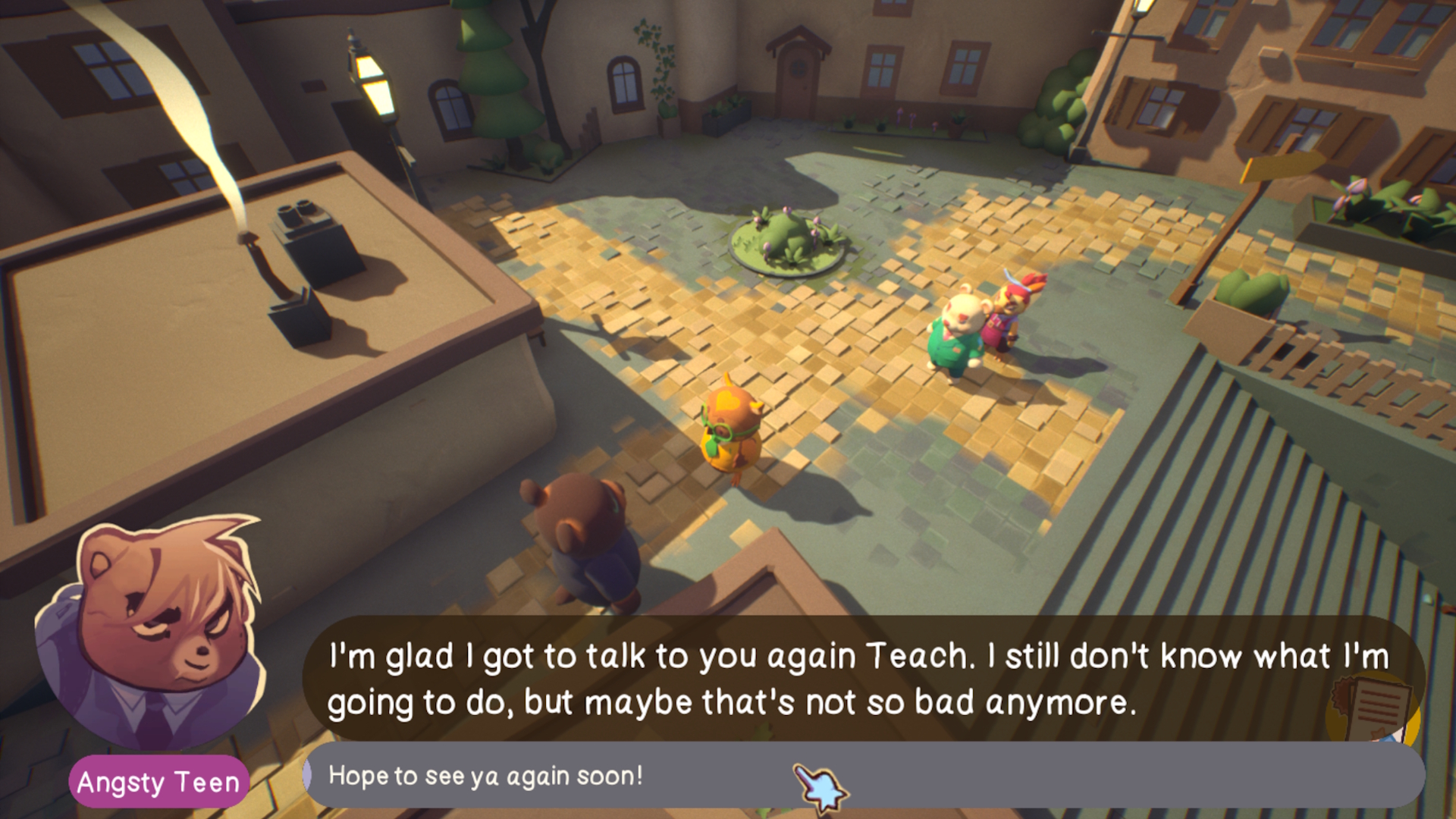
Example of in game dialogue

Project Focus

Every project page I write zooms in on one of four quest design disciplines I work in. For INYIU, that's Narrative Design, though the other three show up along the way too.

Visual Scripting
Encounter Design
Level Design
Narrative Design

INYIU was my first real dive into Narrative Design, and I quickly learned it's about way more than dialogue. It means designing around every system and idea in the game, and constantly talking with people across every other discipline on the team. Scroll down to see how that actually played out, starting with the first boundaries we set ourselves: our pillars.

Design Intent

INYIU is built around sustainability and one simple question: what can YOU do to contribute? Rather than telling players how to act, we used relatable but distanced animal characters to aim for something smaller and more honest: starting a conversation.

INYIU was my first time getting to dive into Narrative design, and since our game was about the more sensitive and educational topic of Sustainability we never wanted to sound like we knew it all, so instead we shifted our focus to getting an open minded conversation as a workshop afterwards. Whether someone related to a specific character or ability, felt strongly about a particular issue, or even came up with their own scenario entirely, all of that mattered, because it meant they walked away specific feelings or even a new point of view on the subject that could be discussed. Those conversations afterwards were really what we were looking for because they allowed people to find our true player experience: Empowerment. The feeling that we are bringing change, together, slowly but surely, even if it is just in doing something small.

We established five strict pillars to be able to reach this goal, and below I will discuss how I tackled each of these when it came to Narrative design and all it's dependencies.

Empowerment

It's not about what you alone can do, but knowing your part inspires someone else's, so together we make the difference.

Stimulate group conversation

Every quest is built so the Urbanimals and topics are relatable enough to spark conversations about what we can do in our own lives.

Work together

Characters combine to solve tasks, since no single Urbanimal gets through a puzzle alone.

One distinct ability

Every character has exactly one defining ability, so players always know who to bring and why.

Sustainability

Every system ties back to real environmental care, never just set dressing.

Tested beyond gamers

Playtested with people who don't usually play games, not just inside the studio.

Light but grounded

The tone stays warm and funny without losing sight of real feelings and real stakes.

Five pillars held up one shared goal, and that goal was all about the player experience we were chasing.

Hover a column for its pillar, or the goal bar for more on the goal · player experience stays fixed as the throughline above both

How the Pillars Shaped My Work

  • Every major interaction needed at least two of the Urbanimals' abilities to resolve, so narrative design meant writing quest logic that could only move forward through cooperation. That meant close collaboration with visual scripting and encounter design to make sure story beats actually required teamwork, not just suggested it.
  • Since every character had exactly one defining ability, quests and dialogue had to give each of them a real moment to shine, never letting one character carry a scene alone. That meant working closely with character and visual design to keep each ability narratively meaningful, not just mechanically useful.
  • Environmental care had to show up in the story, not just the setting, so quests and NPC motivations tied directly back to real stewardship themes. That meant working with level design and art to make sure the world itself reflected what the narrative was saying.
  • Since non-gamers needed to follow the story without prior genre knowledge, dialogue and quest framing had to stay clear without feeling dumbed down. That meant working closely with playtesting and UX to catch exactly where new players got lost.
  • Keeping the tone warm and funny without losing real emotional stakes meant writing dialogue that could hold both at once. That meant working closely with cinematics and audio to make sure the tone landed the same way in voice, animation and writing.
Work together
Worked closely with
Story programmer Level designers
One distinct ability
Worked closely with
2D & 3D Character artists Gameplay programmers Technical designers
Sustainability
Worked closely with
Technical environmental artist Level designers
Tested beyond gamers
Worked closely with
UI/UX designer Level designers Quality of Life programmers
Light but grounded
Worked closely with
2D & 3D Character artists Animators UI/UX designer Lead designer

Feature Breakdown

Dialogue

Even though being a writer and being a narrative designer are not nearly the same thing, I was eager to take on this task as I was the person closest to the game’s narrative design: the world as well as the creation of the characters, from their personalities and abilities to how they work within the game.

I was confident I could write something true that would not only touch on the environmental side of our sustainability question, but also shine a light on its human side: the social aspect our client highlighted as very important.

My goal was for the characters to feel like real people. Without diving too deeply into stereotypes, players should be able to relate to them in a light and funny way, and on a deeper level through their worries, issues and problems.

Although our game relied heavily on narrative, I did not want players to feel forced they had to read every line to understand what was going on, or for it to be heavy all the time.

That is why I split the dialogue into categories, based on what our game required.

Main Quest Dialogues

Every player has to interact with the quest dialogue, as this was the only dialogue you were sure to encounter to some degree when playing the game, so it needed to be short and to the point. Its main job was to give clear instructions and other useful information, without ever making the player feel dumb.

Setting up this dialogue was also the most difficult part, as it sits at the core of the game. A lot of ground rules had to be set first. As feature owner of the 3Cs as well, I worked closely with the Character Artists about what the characters would look like, what their abilities would be, and even what their personalities would be like. After that, I worked closely with the Level Designers to map out how the game would progress, including the order in which characters would be unlocked. Players could even choose which character to unlock first, and so which route to take. Together, we also defined which obstacles (locks) the player would run into along the way, and which character abilities (keys) were needed to continue.

Together with our Story Programmer and UI/UX designer, we planned out what sort of quest system our game would need, and thus what the raw interactions would look like. Once that was implemented, I could continue mapping out every possible dialogue option, such as what happens when a player tries to talk to a character before the quest is finished, or afterwards, once that character has already been successfully unlocked.

As a secondary goal, I wove each character’s personality into these lines, even though on the surface their purpose was mostly to relay how to progress.

Early concept of main quest dialogue and which branches had to be included at minimum to give necessary information.

Example of final version of quest dialogue.


Branching Dialogues

The branching dialogue is the more complex category. It was allocated to one specific character whose ability was social: talking with other characters and, above all, listening to their troubles. These conversations go deeper, and a secondary goal was to spark group conversations among players about how each of them felt about these topics, so I had to consider different points of view when writing the responses.

An important constraint was that the game could not be “failed”. Just like in a real conversation, there is no “game over”, but saying one thing or the other can push the conversation in a different direction. Depending on how much the character appreciates your answer, the conversation might take longer or shorter. There is no clear right or wrong, as the aim is a conversation that feels human, in which players form their own opinion, whether or not they have experience with the topic.

Our main branching interaction was saved for unlocking the final character. As the largest conversation, it had the most elaborate branches: it was built up in sections, and a single answer could either fast-forward you to the next section or take a detour to a new question with three more options, each with its own response.

Everyone still makes it down the tree, but might take a different path than the person next to them, or get a new point of view when playing a second time. Since you always arrive at the final destination, you help them because you took the time to listen, not because of the answers you gave. That is the feeling we wanted to give with this character: this too is a way to help the people beside you.

These are concepts and early designs of the characters in our game that have conversations that require you to listen a little deeper.

Example of final version of branching dialogue.


NPC Dialogues

The NPC dialogue was originally meant to showcase the characters’ personalities even further and to populate the world with NPCs you could have small, lighthearted conversations with. It was the opposite of the branching dialogue: short, funny and characteristic moments that stick with players, give them something to joke about afterwards, and help them remember their favourite playable character.

During playtesting, we noticed that players often talked to NPCs when they were stuck or unsure what to do. Together with my Lead, we decided to pivot and change the purpose of these interactions, having them serve not only the Light But Grounded pillar, but also the Tested Beyond Gamers pillar. Since we already had an existing Hints System, we decided to combine this with the NPC dialogue so it could track which quests and characters were unlocked and what stage the player was at, and give verbal hints accordingly.

The lines differed depending on which playable character the player controlled, so each personality still shone through while giving useful information. They also adapted to how often the player had asked for help and how long they had been struggling: a vague hint at first, slowly guiding them towards the straightforward solution over time. Unfortunately, due to the time limit, this system did not make it out of the testing phase and into the final game.

These images show a specific example of every stage of development for our NPC interactions.

1 is the original chatter between playable characters, 2 is the unique dialogue between characters and NPCs, which is what we ended up with, and 3 is an example of the hint system integrated in our NPC dialogue.

Examples of final version of NPC dialogues

Cinematics

The cinematics were our visual representation of the narrative and story progression in the game. They were completely separate from the stories told in the quests and by the characters. Instead, they tell a bigger story about the world, the characters living in it, and how their actions changed it for the better.

The cinematics mostly represent the Sustainability pillar, as they tell the story of how the world comes back to life once the characters work together to slowly but surely do their part. We chose to convey this through cinematics because our game had to appeal to a very large audience, mostly non-gamers. We wanted to tell a story where gameplay enhances this feeling, instead of the other way around.

Since the story structure is straightforward, we opted for no more than a beginning, middle and end sequence, and kept the length to a minimum so as not to overwhelm players. We wanted to tell a story, but that is not the main goal of our game. The goal is to bring focus to sustainability issues and get people thinking about them themselves, so a conversation can continue from there.

Below, I go into more detail on these beginning, middle and ending sequences, how they evolved into the end product, and the design choices behind them.

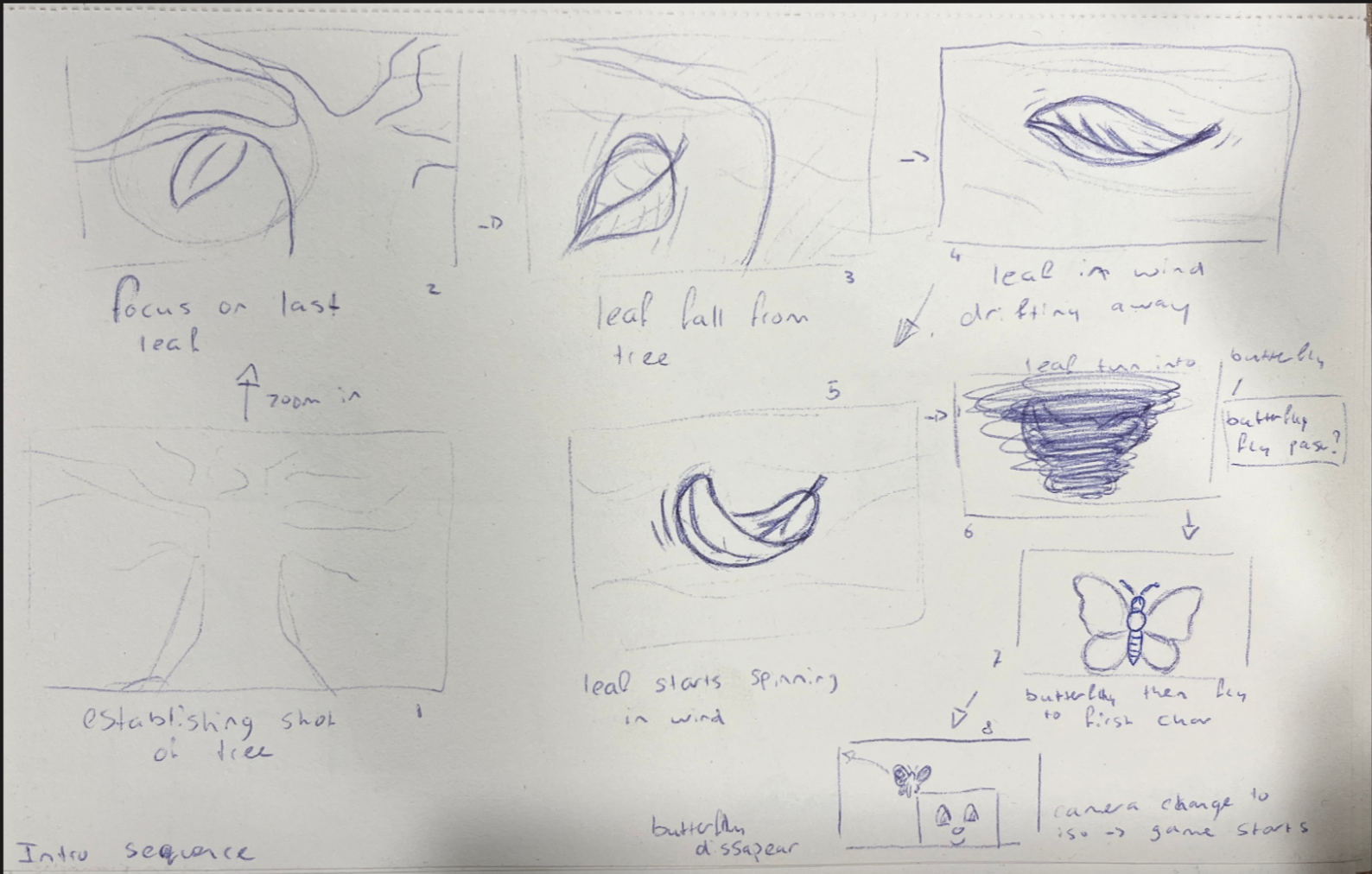
Concept idea for the intro sequence
Concept

Intro Sequence – Begin

As the beginning of the game and the first thing a player sees, the intro sequence had one job: to establish the goal and first playable subject of the game.

It starts by introducing the long-term goal of the game, the tree. Seeing it struggle shows that our game is not just about solving quests, but about the deeper topic of sustainability.

Next, it shows part of the level. This was intentional, as our level design was built with foreshadowing in mind. It makes the player curious to explore more of the map later on, and it already presents the first area they will have to move towards, giving them a small hint within the opening sequence.

Lastly, we get to the first character. A falling leaf from the dying tree blows all the way to them, which we used to build an emotional connection with the story and to let players connect with the playable characters. The camera never gets too close though, since a certain distance always had to remain.


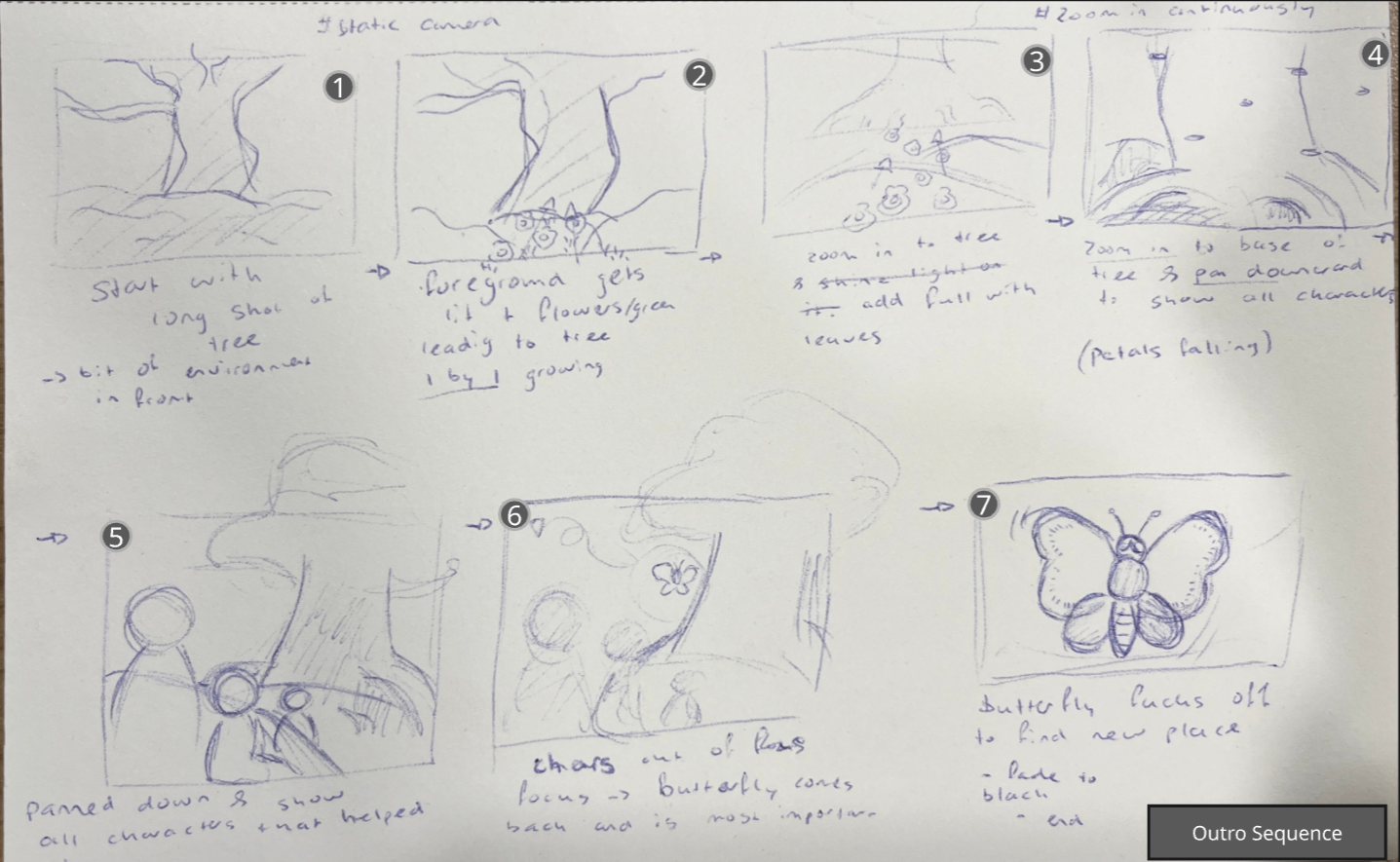
Concept idea for the outro sequence
Concept

Outro Sequence – End

The main goal of the outro sequence was to create a feeling of empowerment by showing everything the Urbanimals accomplished together: the transformation of the tree into a healthy, blooming one.

As mentioned in the section above, the tree is our simple but effective reference to the large and inescapable sustainability problem. Throughout the game, you see it gaining back its leaves and life. By the end it is not only healthy: seeing every character that contributed to this result again reminds players one final time that such a large achievement is not done alone, and that everyone has unique abilities to help out with.

The sequence closes off the game regardless of how you played or how you helped out, by showing that there is hope and that this small town is a representation of our own out there. It pulls us out of the game and story and back into our own lives. It’s supposed to get players thinking about how to apply what they have just come across, and put them in the right mindset for the group conversation afterwards, which is part of the INYIU experience.


Concept

Tree Update Sequences – Middle

This sequence was pretty difficult to work out. It was shown every time a character around town was aided, whether with physical labor or emotional support. Because it would appear so often, it could not take up too much time, yet it still had to convey the right information in only a couple of seconds: that the players, or rather the Urbanimals’ actions, were having a positive effect on the long-term goal we had established, the tree, which was slowly coming back to life.

We decided to make the first showing longer, since it was part of the onboarding phase and had to teach players that the tree they saw in the opening sequence had a purpose and that their actions were mending it. After that, we only showed a brief update: a shorter sequence that updated the state of the tree and gave consistent feedback.

The creation of the sequence, and the transition of the tree growing, was done in conjunction with our Technical Artist and UI/UX designer. I had to create modular sequences, using events within the director blueprint, so that designers on my team could easily implement each separate tree update per stage, as well as feedback for our quest system that would be triggered before or after these sequences ran.

3Cs

This section is still under construction and will soon be made public.

Project Takeaways

This was a project where I had to put on many hats, and I got to try a lot of them on for the first time, such as being a Quest and Narrative designer, in a team of this size. Because there were so many firsts, there was a lot we had to figure out as we went along, and I ran into plenty of new obstacles that needed time and attention to overcome.

I found it quite difficult at first to find my place in a big team full of unfamiliar faces, especially because I had so many overlapping responsibilities that I had to communicate with just about everyone. In the beginning it was a challenge to simply walk up to people, but as the project went on we organised some team-building events and I made an effort to get to know my teammates better. During our team feedback sessions I was told that some of them felt the same, or had been waiting for me to approach them, which made it much easier for me to make the first step.

I also struggled with taking on more work than was realistic, and with feeling that I had to shoulder all of those responsibilities by myself. My schoolwork and documentation were the first things to suffer, until I realised I couldn’t keep going like this and started to rely on my teammates by handing off small portions of my work. That strengthened my communication skills. Up until then I was the sole creative owner and knew exactly what needed to be done, but now I had to trust that my documentation and explanation of a feature were enough to guide a teammate to the right outcome. I learned to let go and delegate, and to keep an overview of the entire project, including my teammates’ strengths and who I could rely on for which problems, so that my work could be as efficient as possible. Near the end, my own output almost doubled, my communication skills and the team atmosphere clearly improved, and I even managed to do my schoolwork on the side.

Getting this first experience as a Quest and Narrative designer has shown me just how much of a jack-of-all-trades you have to be, how important good communication is, and how much it matters to keep your own documentation in order, so that everyone understands what you are doing and can easily work with your tools.

If I got to do this project again with the knowledge I have now, I would make sure to take on fewer responsibilities from the get-go, or set up proper documentation immediately so my teammates could take over some of my workload. That would leave me more time to properly research and learn the true basics and foundations of what it means to design quests for a narrative-heavy game like this. I am someone who learns by doing and working as I go, but I feel I could have reached an even better outcome if I had created time and breathing room for myself to take a step back, assess my own design choices and properly understand what I was doing, instead of rushing iterations because of the pressure of an impending deadline.